
Description
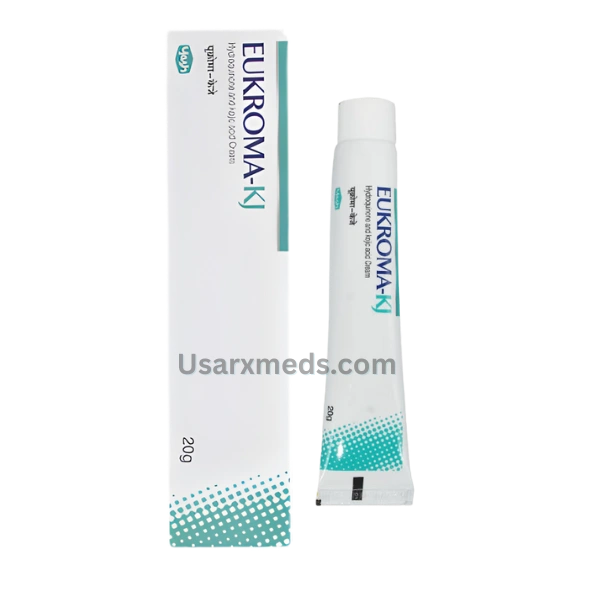
What Is Eukroma KJ Cream?
Eukroma KJ Cream is a topical depigmenting treatment containing Kojic Acid Dipalmitate that reduces melanin production to fade dark spots, melasma, and skin discoloration. Manufactured by Yash Pharma Laboratories. The “KJ” denotes Kojic Acid formula a hydroquinone-free alternative to standard Eukroma cream.
Kojic Acid Dipalmitate is a stabilized, lipid-soluble form of Kojic Acid. More stable than pure Kojic Acid. Less irritating. Better skin penetration.
This formulation suits individuals who:
- Cannot tolerate hydroquinone
- Prefer non-hydroquinone options
- Need long-term maintenance therapy
- Have sensitive skin prone to irritation
How Eukroma KJ Cream Works
Skin color comes from melanin pigment produced by cells called melanocytes. Hyperpigmentation occurs when melanocytes overproduce melanin in certain areas.
Kojic Acid Dipalmitate inhibits tyrosinase the key enzyme required for melanin synthesis.
Mechanism breakdown:
- Blocks tyrosinase activity: Prevents conversion of tyrosine to melanin precursors
- Chelates copper ions: Tyrosinase needs copper to function Kojic Acid binds copper, deactivating the enzyme
- Reduces melanin transfer: Less pigment reaches upper skin layers
- Antioxidant properties: Protects against oxidative stress that triggers pigmentation
Results appear gradually. Existing pigmentation fades as skin naturally turns over (approximately 28-day cycle). New melanin production slows simultaneously.
Typical timeline: Visible improvement in 4-8 weeks with consistent use.
Conditions Treated
Primary Indications
| Condition | Description |
|---|---|
| Melasma | Brown/gray patches on face (cheeks, forehead, upper lip) |
| Solar lentigines | Age spots/sun spots from UV exposure |
| Post-inflammatory hyperpigmentation (PIH) | Dark marks left after acne, injuries, or inflammation |
| Freckles | Small concentrated pigment spots |
| Uneven skin tone | General blotchiness and discoloration |
Secondary Uses
- Underarm darkening
- Inner thigh pigmentation
- Elbow and knee darkening
- Neck discoloration
- Pregnancy mask (after delivery not during pregnancy)
Application Instructions
How to Apply
- Cleanse skin thoroughly with gentle cleanser
- Pat dry completely don’t apply to damp skin
- Apply thin layer only to pigmented areas
- Massage gently until absorbed
- Apply sunscreen (SPF 30+) every morning mandatory
Dosing Frequency
| Phase | Application | Duration |
|---|---|---|
| Initial treatment | Once daily (night) | First 2 weeks |
| Standard treatment | Twice daily | 8-12 weeks |
| Maintenance | Once daily or every other day | Ongoing as needed |
Important Application Tips
- Nighttime application preferred : Kojic Acid increases photosensitivity
- Spot treatment only : apply to dark areas, not entire face
- Pea-sized amount : sufficient for facial spots
- Avoid eye area : keep at least 1 cm away from eyes
- Wait 10 minutes : before applying other products
- Consistent use required : skipping applications delays results
Storage
- Room temperature (below 25°C/77°F)
- Keep tube tightly closed
- Avoid direct sunlight
- Don’t refrigerate
- Discard if color changes or separation occurs
Side Effects
Common (Usually Temporary)
- Mild stinging on application (first few uses)
- Slight redness
- Dryness or flaking
- Temporary increased sensitivity
These typically resolve within 1-2 weeks as skin adjusts.
Less Common
- Contact dermatitis
- Itching
- Burning sensation
- Skin peeling
When to Stop Use
- Severe redness or swelling
- Blistering
- Intense burning that doesn’t subside
- Allergic reaction signs (hives, difficulty breathing)
- Worsening of pigmentation
Sensitivity Note
Kojic Acid Dipalmitate is gentler than pure Kojic Acid or Hydroquinone. However, some individuals still experience irritation. Patch test recommended before full application.
Patch test method:
- Apply small amount behind ear or inner forearm
- Wait 24-48 hours
- If no reaction, proceed with treatment
- If redness/itching occurs, discontinue
Precautions and Contraindications
Do NOT Use If
- Allergic to Kojic Acid or any cream ingredients
- Open wounds, cuts, or broken skin in treatment area
- Active skin infections
- Severe eczema or psoriasis on treatment area
- Currently using prescription retinoids (without doctor guidance)
Use With Caution
| Situation | Recommendation |
|---|---|
| Sensitive skin | Start every other night, build tolerance |
| Rosacea-prone skin | Consult dermatologist first |
| Using other actives (AHA, BHA, Vitamin C) | Introduce slowly, watch for irritation |
| History of contact allergies | Patch test essential |
Pregnancy and Breastfeeding
Limited data on topical Kojic Acid during pregnancy. Generally considered low risk due to minimal systemic absorption. However, consult healthcare provider before use during pregnancy or breastfeeding.
Sun Protection Non-Negotiable
Sunscreen is mandatory during Eukroma KJ treatment.
Why this matters:
- Kojic Acid increases skin’s UV sensitivity
- Sun exposure triggers more melanin production counteracts treatment
- Unprotected sun exposure can worsen pigmentation
- Even brief exposure causes setbacks
Sun Protection Requirements
- SPF 30 minimum SPF 50 preferred
- Broad-spectrum (blocks UVA and UVB)
- Apply every morning regardless of weather
- Reapply every 2 hours if outdoors
- Physical sunscreens (zinc oxide, titanium dioxide) often better tolerated with depigmenting treatments
- Wear hats and seek shade when possible
No sunscreen = no results. Treatment becomes pointless without UV protection.
Eukroma KJ vs. Regular Eukroma (Hydroquinone)
| Feature | Eukroma KJ (Kojic Acid) | Eukroma (Hydroquinone) |
|---|---|---|
| Active ingredient | Kojic Acid Dipalmitate 2% | Hydroquinone 4% |
| Potency | Moderate | Strong |
| Speed of results | 6-12 weeks | 4-8 weeks |
| Irritation potential | Lower | Higher |
| Long-term use | Safer for extended use | Limited to 3-5 months |
| Ochronosis risk | None | Possible with prolonged use |
| Pregnancy safety | Likely safer (consult doctor) | Not recommended |
When to Choose Eukroma KJ
- Sensitive skin that reacts to hydroquinone
- Need for long-term maintenance therapy
- Mild to moderate pigmentation
- Post-hydroquinone maintenance phase
- Preference for non-hydroquinone products
When Hydroquinone May Be Better
- Stubborn, deep melasma
- Need faster results
- Short-term intensive treatment
- Under dermatologist supervision
Maximizing Results
Complementary Ingredients
Eukroma KJ works well alongside:
| Ingredient | Benefit | How to Combine |
|---|---|---|
| Vitamin C serum | Antioxidant, brightening boost | Apply morning, Eukroma KJ at night |
| Niacinamide | Reduces melanin transfer | Can layer apply before Eukroma KJ |
| Alpha Arbutin | Additional tyrosinase inhibition | Alternate nights or different times |
| Azelaic Acid | Mild depigmenting, anti-inflammatory | Use on alternate nights initially |
Ingredients to Avoid Combining
- Retinoids (tretinoin, adapalene) : increased irritation risk. If using both, apply on alternate nights.
- Strong AHAs/BHAs (glycolic acid, salicylic acid at high %) over-exfoliation risk
- Benzoyl peroxide : can cause excessive dryness
- Other hydroquinone products : unnecessary, may increase irritation
Lifestyle Factors
- Avoid picking at pigmented spots
- Manage hormones if melasma related to birth control
- Control inflammation : treat acne promptly to prevent PIH
- Reduce friction : tight clothing worsens body pigmentation
Expected Timeline
| Week | What to Expect |
|---|---|
| 1-2 | Skin adjusting. Possible mild dryness. No visible change yet. |
| 3-4 | Slight softening of pigmentation edges. Skin tone looks more even. |
| 5-8 | Noticeable fading of spots. Melasma appearing lighter. |
| 9-12 | Significant improvement. Most surface pigmentation reduced. |
| 12+ | Maintenance phase. Continue for sustained results. |
Deep dermal pigmentation (melasma extending into dermis) takes longer sometimes 6+ months. Manage expectations accordingly.
Frequently Asked Questions
How long before I see results?
4-8 weeks minimum. Skin cell turnover takes roughly 28 days. New, less-pigmented cells need time to reach the surface. Deep pigmentation requires 3-6 months. Consistency determines outcomes.
Can I use Eukroma KJ on my whole face?
Not recommended. Apply only to pigmented areas. Whole-face application wastes product and may cause uneven lightening or unnecessary irritation to normal skin.
Can I use makeup over Eukroma KJ?
Yes. Wait 10-15 minutes after application for full absorption. Apply sunscreen first, then makeup. Cream should be fully dry before layering products.
What happens if I stop using it?
Pigmentation may gradually return especially with sun exposure or hormonal triggers. Many users continue maintenance application (2-3 times weekly) to sustain results. Consistent sunscreen remains essential permanently.
Can I use this on dark underarms?
Yes. Eukroma KJ effectively treats underarm hyperpigmentation. Apply thin layer once daily at night. Avoid immediately after shaving wait 24 hours. Wear loose clothing during treatment.
Is Kojic Acid safe for dark skin tones?
Generally yes. Kojic Acid is considered safer for darker skin than hydroquinone lower risk of paradoxical darkening or ochronosis. Start slowly and monitor for irritation. Darker skin tones sometimes experience more sensitivity.
Can I use with tretinoin/retinol?
Cautiously. Both increase skin sensitivity. If combining:
- Use on alternate nights initially
- Build tolerance over 4-6 weeks
- Watch for excessive dryness, peeling, redness
- Some dermatologists recommend tretinoin at night, Eukroma KJ in morning (with sunscreen)
My skin is peeling is this normal?
Mild peeling can occur initially. Reduce frequency to every other night until skin adjusts. If peeling is severe or accompanied by burning/redness, stop use and consult a dermatologist. Moisturizer applied 20 minutes after Eukroma KJ helps.
How is this different from Eukroma Plus?
Eukroma Plus contains Hydroquinone + Tretinoin + Mometasone (steroid). It’s a prescription triple-combination cream for stubborn melasma. Eukroma KJ contains only Kojic Acid no steroids, no retinoids. Gentler formula suitable for long-term use without steroid side effects.
Does it expire?
Yes. Check tube for expiration date. Generally stable for 24-36 months unopned. Once opened, use within 6-12 months. Discard if cream changes color (yellowing) or texture.
Why usarxmeds?
- Genuine Yash Pharma manufactured Eukroma KJ
- Proper storage maintained product integrity preserved
- Discreet unmarked packaging
- Secure checkout
- Reliable USA shipping with tracking
- Customer support available
Disclaimer: Educational content only. Not medical advice. Persistent or worsening hyperpigmentation should be evaluated by a dermatologist to rule out underlying conditions. Results vary by individual skin type and pigmentation depth.






Reviews
There are no reviews yet.