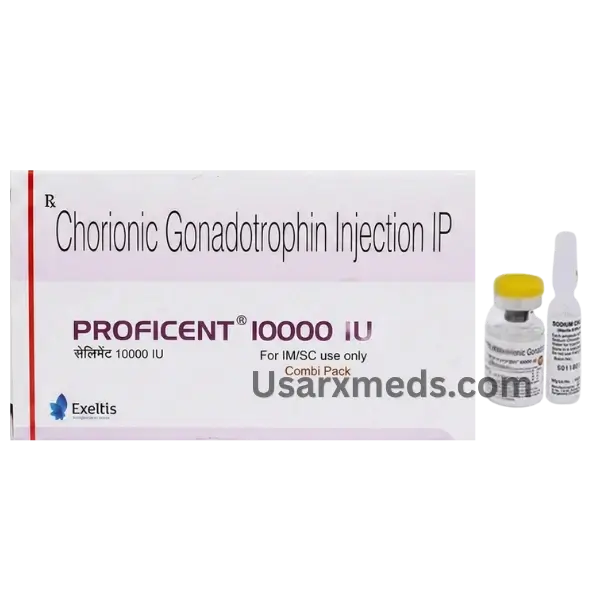
HCG Injection – Proficent 10000 IU is a prescription hCG injection used in fertility treatments, most often as an ovulation trigger. It contains human chorionic gonadotropin, a hormone that mimics the body’s natural LH surge to help the egg mature and be released at the right time. Because timing is critical for female fertility support and procedures like IUI or IVF, Proficent 10000 IU should be used only under a fertility specialist’s guidance.
HCG Injection – Proficent 10000 IU is a medication most people learn about in the middle of a fertility cycle, usually right when things start to feel serious and time-sensitive. It’s often called a “trigger shot,” and that name fits. The whole purpose of hCG is to trigger the final steps that lead to ovulation, so your clinician can time intercourse, IUI, or egg retrieval with much more precision than a natural cycle allows.If you’re in a monitored cycle, you already know fertility treatments are basically a mix of biology and scheduling. The trigger is one of the most important “schedule” moments.
What is hCG and why is it used?
hCG stands for human chorionic gonadotropin. In the body, it’s a hormone best known for pregnancy, but in fertility medicine it’s used because it acts similarly to luteinizing hormone (LH). In a natural cycle, an LH surge tells the ovary it’s time to release a mature egg. In fertility treatments, hCG can mimic that surge and cue the ovary to complete egg maturation and ovulation.That’s why Proficent 10000 IU is used as female fertility support. It helps your clinician control timing, which can be the difference between a well-timed cycle and a missed window.
When Proficent 10000 IU is typically prescribed
Clinics may prescribe an hcg injection like Proficent 10000 IU for:
Ovulation induction cycles when follicles are ready
IUI cycles to schedule insemination at the best time
IVF cycles to time egg retrieval
Some protocols where hCG is used as part of luteal support, depending on clinic strategy
Your specific plan depends on ultrasound results, hormone levels, and how your ovaries respond to stimulation.
Timing: why it’s so strict
You’ll often be told to take the trigger at an exact time, sometimes down to the minute. That can feel intense, but there’s a reason. Ovulation usually happens within a predictable window after the trigger. Procedures like IUI and egg retrieval are scheduled around that window.If you take it late or early, the whole cycle timing can shift. If you’re unsure, call your clinic rather than guessing.
How it’s mixed and given
Many hCG products come as a powder that needs to be mixed with a diluent before injection. Depending on the formulation and clinic protocol, it may be injected:
Your clinic should teach you the correct technique. If you haven’t been trained, ask before trigger day. It’s much easier to learn calmly than when you’re stressed and watching the clock.General handling reminders:
Use clean technique and wash hands.
Use the correct syringe and needle size.
Do not reuse needles.
Mix only as directed and use within the timeframe your pharmacist or clinic recommends.
Side effects and what to watch for
Common side effects can include:
Injection site soreness, redness, or mild swelling
Bloating or pelvic discomfort
Headache
Mood changes
Because hCG is often used in stimulated cycles, it can also be associated with OHSS (ovarian hyperstimulation syndrome), especially in high responders. OHSS risk is influenced by the number of follicles and estrogen levels, not just the trigger itself.Call your clinic promptly if you have:
After an hCG trigger shot, home pregnancy tests can show positive simply because hCG is still in your system. Clinics often give specific timing on when to test so results are meaningful. If you test too early, it can mess with your head unnecessarily.
Storage
Storage depends on the product. Some hCG needs refrigeration after mixing, while the unmixed powder may be stored at room temperature. Follow the label and pharmacist instructions exactly.
Available Strengths (As Available in the Market)
hCG injections are commonly available in:
1,500 IU
2,000 IU
5,000 IU
10,000 IU (Proficent 10000 IU)
Some clinics also use recombinant hCG products labeled differently (such as 250 mcg). Your clinician chooses based on protocol and availability.
FAQs
1) What is HCG Injection – Proficent 10000 IU used for?
It is used in fertility treatments, most commonly as an ovulation trigger to help time ovulation for intercourse, IUI, or IVF egg retrieval.
2) How soon after the hCG injection will I ovulate?
It varies, but ovulation is often expected roughly 24 to 48 hours after the trigger, depending on your protocol. Your clinic schedules procedures based on this window.
3) Can Proficent 10000 IU cause a false positive pregnancy test?
Yes. Since the injection contains hCG, it can show up on home pregnancy tests for a while after the trigger. Follow your clinic’s timing for accurate testing.
4) What side effects are common with hCG injections?
Injection site soreness, bloating, pelvic discomfort, and headache are common. Severe symptoms like significant swelling or breathing trouble should be reported urgently.
5) Do I need monitoring with fertility trigger shots?
Yes, typically. The trigger shot is usually given after ultrasound and sometimes bloodwork confirm follicles are ready. Monitoring improves timing and helps reduce risks like OHSS.
size
3 Vial/s, 6 Vial/s, 9 Vial/s
⭐ Reviews
Reviews
There are no reviews yet.
Be the first to review “Proficent 10000 IU | HCG Injection” Cancel reply
Reviews
There are no reviews yet.